In the past decade, human-caused global warming has gone from a hotly debated theory to a widely accepted, scientifically validated truth. Simultaneously, many of the world’s countries have banded together under the United Nations Framework Convention on Climate Change and in various climate-related treaties to fight back, cut greenhouse gases, and hopefully cool the heat before more damage is done.
The most expansive of these treaties, the Kyoto Protocol — which legally committed countries to reaching benchmarks, placed the bigger burden on developed countries, and established a viable emissions trading market — is set to expire in 2012. To ensure the protocol’s accomplishments do not melt five years from now like the icebergs it’s trying to save, the United Nations and the nearly 200 countries who signed on are scrambling to establish a sequel to Kyoto. That mad rush will reach its peak next week on the Indonesian island of Bali, where the United Nations Climate Change Conference (UNCCC) is going down for two weeks starting on December 3.
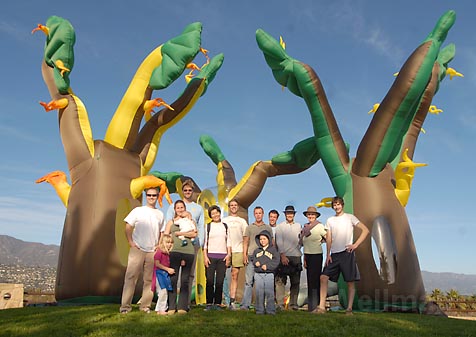
But as the global media turn their cameras toward Bali next week to watch the planet’s leading politicians try to save the world, the visuals most likely to grace televisions screens from Jakarta to Johannesburg won’t be of gray-suited diplomats negotiating in a map-filled room over a paper-strewn conference table. Rather, the shots you’ll probably see plastered across the New York Times and on CNN will be of giant inflatable trees, posted with UN permission just outside the convention to symbolize the progress of the talks through their changing tones and shapes. And these soon-to-be-famous trees — which will stand 20-feet tall when talks are going well for the environment but will sprout inflatable flames if they go sour — have roots in Santa Barbara.
Envisioned, sponsored, and coordinated by the Tropical Forest Group (TFG) — a nonprofit headquartered in the S.B. foothills that’s dedicated to fighting deforestation — and created by Summer Solstice Parade artist Pali-X-Mano, these trees are just part of the publicity package being unveiled in Bali. The two-year-old TFG — which was launched by a team of scientists, lawyers, and activists led by environmental consultant John-O Niles in time to produce similar media stunts during the 2005 UNCCC in Montreal — is also hosting Balinese dancers during the conference’s main negotiation day, supporting a team of bloggers from Yale University who’ll report live on the talks, and providing technical support inside the talks for countries who need the help. Other Santa Barbara companies lending a hand include Boxtales, which provided theatrical visioning, Solforce, which is donating solar panels to power the trees, and Powell Skateboards, which is giving manpower and supplies as well.
“Saving tropical forests is priority number one, and in doing so, we’re also fighting climate change.”
So why is a nonprofit focused on saving tropical forests taking center stage at a climate change conference? According to TFG executive director Jeff Metcalfe, tropical deforestation is “a huge but less recognized source of greenhouse gas emissions. … Deforestation is just part of the negotiations, but when that is on the front page, attention is drawn to fighting deforestation as a means of reducing climate change.” The cutting down and burning of tropical forests for warmth and cooking amounts to about 20 percent of global emissions while at the same time reducing the number of trees that would otherwise turn that carbon dioxide into oxygen. “We have a two-fold mission,” said Metcalfe, a Michigan native who works as a marketing consultant to pay the bills. “Saving tropical forests is priority number one, and in doing so, we’re also fighting climate change.”
Although the nonprofit, which formally incorporated as a 501(c)(3) this year, will be making the biggest waves in Bali, they’re also quietly supporting tropical forest conservation work around the world. “What we look for are projects that are ideally protecting areas from becoming deforested,” Metcalfe said. “If they are reforesting projects, we make sure they’re using indigenous species. But rather than getting into a country and starting something new, we look for projects that are already doing well and meeting certain success criteria.” The group lends a special hand to forests in conflict regions, where governments and other nonprofits are typically busy dealing with more pressing humanitarian concerns.
Domestically, TFG is raising awareness that the American government — which is one of the few developed nations to have backed out of Kyoto — is continually trying to cut back its financial commitment to saving such forests. Meanwhile, the rest of the world is realizing, thanks to a November report from the Intergovernmental Panel on Climate Change, that “saving tropical forests is one of the fastest, cheapest, smartest, and most equitable ways to fight climate change,” explained Niles, a TFG cofounder.
Why should the American government care about forests that aren’t within its borders? “They house more than half of the Earth’s species, so they’re valuable in that respect,” said Metcalfe. “But the tropical forests are also more threatened because there is a huge demand for products that involve clearing them, such as cattle, coffee, and soybeans. There’s a high demand for that agricultural land, and it’s being deforested at the rate of 30 million acres per year.”
It’s facts like this that Metcalfe, Niles, and the rest of TFG hope will become widespread wisdom due to their involvement in the December talks in Bali. And until then, be on the lookout for inflatable trees on your TV screen.
4•1•1
For more information, see tropicalforestgroup.org.

Double-clicking on any word or phrase in this story will open a reference window with definitions and links to other reference material.

Print friendly
E-mail story
Contact an Editor
iPod friendly
Comments
Bookmark This
Previous Month


Comments
Discussion Guidelines
I'm sorry but I have a real problem with the "scientifically validated truth" statement. I have no problem whatsoever believing climate change is happening. I have no problem believing it has been a hotly debated theory and I even have no problem with it being a widely accepted theory or a high likely hood it is caused by man but I haven't seen a shred of solid proof it has been caused by man. I have seen plenty of people out there insisting we are the cause. But when it comes to proof are we just supposed to believe somebody we have never heard of? I know I am atypical but I don't work that way. If there is proof out there please point it out but unless you can I don't buy it and I am not going to. I am simply convinced I am not obligated to believe people just because they think I should. I decide my own belief system, thank you. I am 110% for saving the forests. I am all for cutting emissions and most of what the environmental crowd is asking for but I also value the truth. I spend time almost every single day reading up about gullible warming and I have never seen anything indicating it went from theory to fact. Can you provide links to any science that indicate that?
skeptical (anonymous profile)
November 29, 2007 at 3:48 p.m. (Suggest removal)
Thanks for reading and keeping your mind open.
Science itself is a way of looking at the world based on testable theories, and the “truths” are merely the theories we’ve come to accept after much investigation. I would say that human-influenced global warming theories have reached that level of “truth,” in that there are no honest, peer-reviewed scientists willing to say that it’s not happening.
Certainly, plenty of people agreed that the earth was round before ever seeing it from space, even though that was “just a theory.” Of course, some still believe the earth is flat even after seeing if from space, and it seems that those who aren’t yet buying into human-caused global warming are this generation’s flat-earthers.
For more info, see the Intergovernmental Panel on Climate Change’s website ipcc.ch. And check out their latest report at ipcc.ch/ipccreports/ar4-wg1.htm.
Matt (Matt Kettmann)
November 29, 2007 at 4:21 p.m. (Suggest removal)
Your words: "In the past decade, human-caused global warming has gone from a hotly debated theory to a widely accepted, scientifically validated truth."
Had I written that statement for a paper in any college, or even high school, class I would have had to justify and defend it. It would be nice if you were to make an effort do so. I expect no less from this publication.
While there is some evidence of a general warming trend in the world's climate, it's unfortunate that the media, led by what we fondly call "the alternative press", have seized on the blather of "human-caused global warming and run with it. While it may be a theory, it's NOT widely accepted by anyone other than the lockstep flock, it's NOT scientifically validated, and it's NOT the "truth". There appear to be far more highly qualified scientists in the field of climatology questioning the validity of this theory than are in acceptance, but their voices are being drowned out, much like a child covering his ears and yelling "I can't hear you" to a scolding parent. Penn and Teller have a word for this ............
If you're depending on the IPCC for your information, you're seeing only one side, the agenda of which is vigorously defended by ad hominem attacks on those who don't share "the vision".
I suggest you begin your search for the REAL story by reading the following link, and then watching the video material referenced therein.
http://newsbusters.org/blogs/noel-sheppa...
warming-tutorial-media-should-be-required-watch
Krusty (anonymous profile)
November 29, 2007 at 5:51 p.m. (Suggest removal)
"While it may be a theory, it's NOT widely accepted by anyone other than the lockstep flock, it's NOT scientifically validated, and it's NOT the "truth"."
That's really funny--because the "can't prove it's TRUE people" also cannot prove it's not!
"lockstep flock" --are you the lockstep kettle, or the lockstep pot?
. . .
The really sad things about the possibility of global climate change (good or bad), is that we'll probably never be able to prove anything.
If the earth continues to get "warmer", without any effort to change it, then one side will say "I told you so", and the other will continue to deny it. If things cool off, sans extra effort to make it so, then the results will be the same, switching sides.
If the earth gets warmer, WITH efforts to stop it, then it could still be argued that its a "natural" warming, that we cannot overcome, and therefore we aren't the cause--nevermind that, even with changes to enact climate change for the better, there may simply be far too much growth (human and industrial), to more-than-offset the current inertia of the climate. And, if the earth gets cooler, WITH effort, then some may still claim that it's a "natural" cooling, and that it was bound to happen.
I personally think that "global warming" is something like the Earth having a fever, in reaction to the human virus. If you total up the effects of industrialization, deforestation, overproduction of animals for human consumption (which themselves are consuming creatures), pollution-belching automobiles (especially the unnecessarily large-engined variety), the sequestering of H2O from the water table(s)--all kept in plumbing lines, I think we have more than enough population, to make more than a dent in the climate. [A side-note on the automobiles--a friend of mine sees every running vehicle, as a miniature fire. The next time you sit in traffic, imagine each car as a campfire, and then compare it to the effects of the standard SoCal wildfire. Sure, the "smoke" is virtually invisible, but it's still being passed into the air.]
I think many believe the Earth is an open system, due to it's size, yet it ultimately is a closed one. If you juxtapose the scale of human growth (in population and industry), with the baseline of the climate temperature change, you'd probably see some interesting correlations. "An Inconvenient Truth" may have had a part about this, but then again, there are many who deny the message, because of their prejudice against the messenger. . . .
Then again, maybe the real cause of global warming is God. Of course, we can't prove Him either.
equus_posteriori (anonymous profile)
November 30, 2007 at 8:58 a.m. (Suggest removal)
Post a comment