

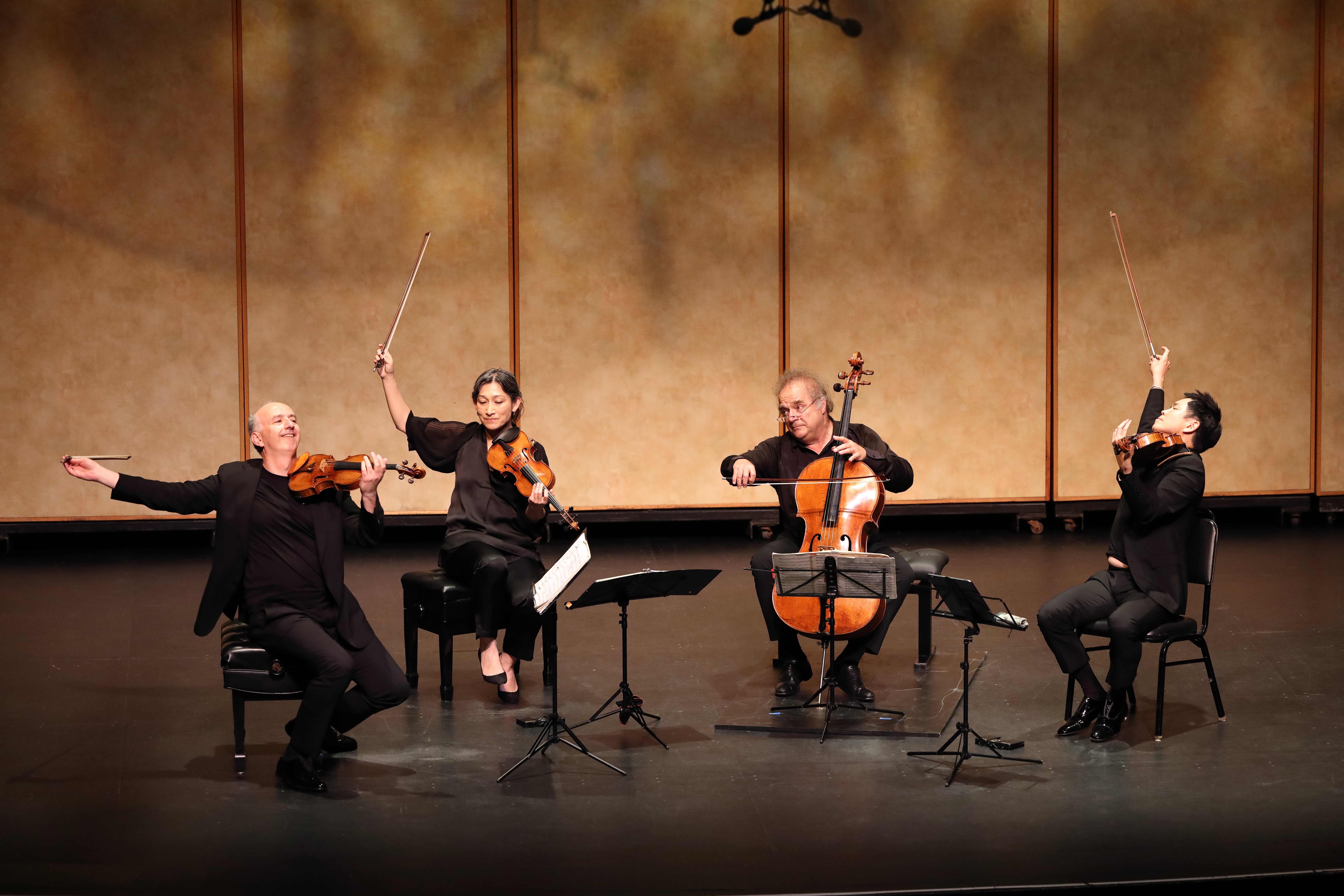
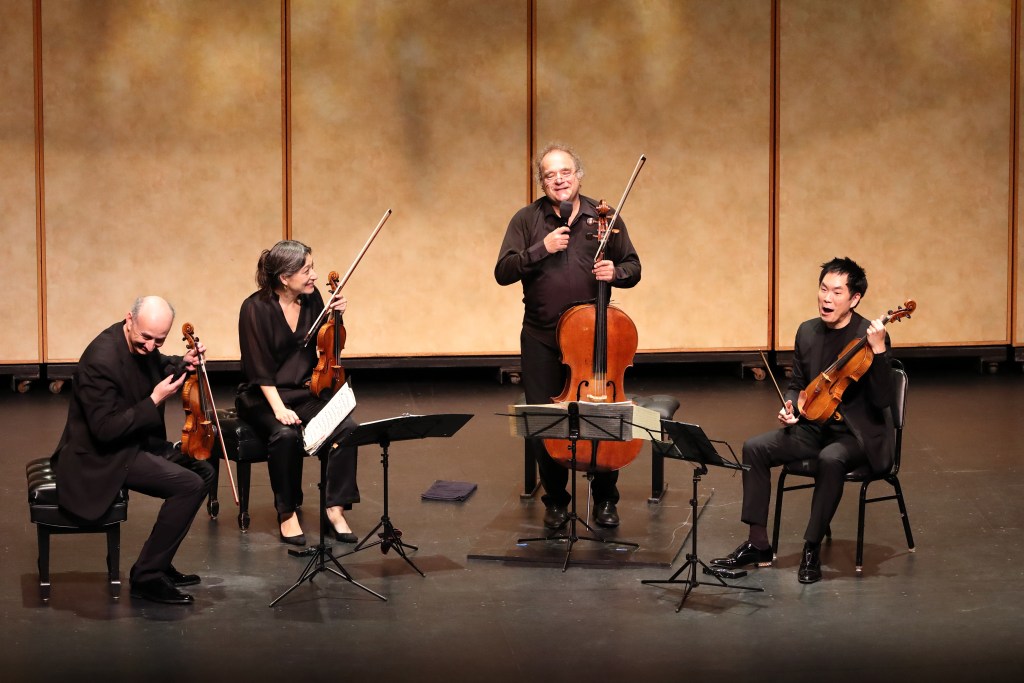
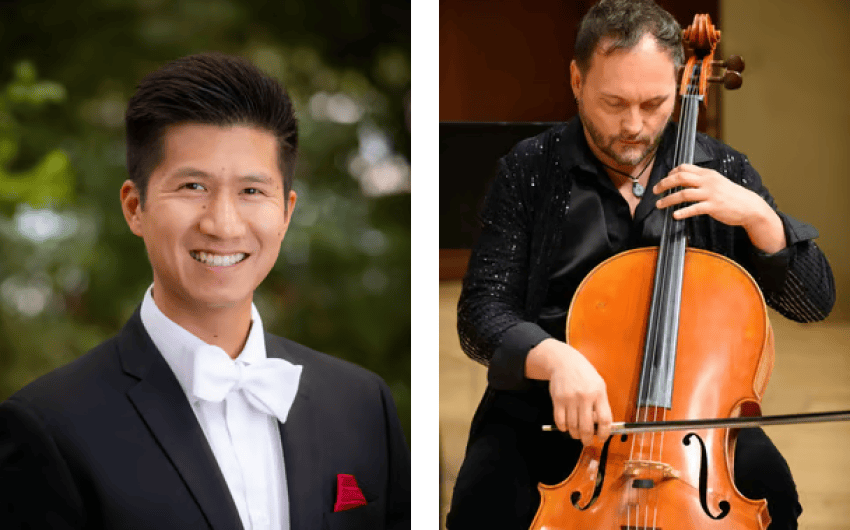
When we think of the interface of the Lobero Theatre and the Takács Quartet — two historic institutions in their own right — a third strong and historic association is the Music Academy of the West (MAW), which has hosted the Hungarian-founded, Colorado-based quartet, now in residence at the University of Colorado Boulder, each summer for more than two decades. We also take comfort in seeing the long-standing and last remaining founding member, cellist András Fejér. He has been a stalwart point of continuity and keeper of the flame, where the quartet was founded at Budapest’s Franz Liszt Academy in 1975.
That illustrious pact ended at the Lobero on Saturday, with the final official performance with Fejér, retiring after 51 years in the ranks. The musical subject was Beethoven’s quartet repertoire, spanning the early, middle, and late periods (the majestic Opus 131), and the group delivered the goods with bounteous musical prowess.
In her introduction to the Quartet’s virtually annual early summertime recital at the Lobero Theatre, Music Academy of the West head Shuana Quill gave thanks to enabling patrons and also to former Music Academy director NancyBell Coe, who first invited the famed quartet to the MAW family. Other Takács chairs have changed players through the years, most recently with the addition of violist Richard O’Neill, who Santa Barbarans knew from his work with Camerata Pacifica. But Fejér was a link to the origin story and the Hungarian connection.
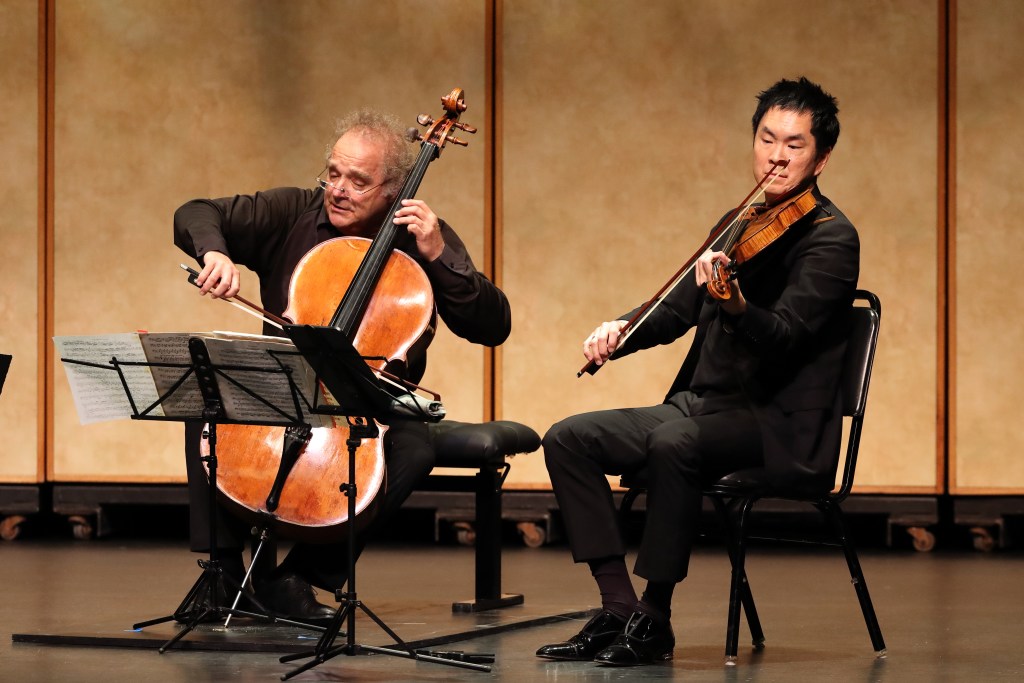
First violinist Edward Dusinberre opened by noting that “he’s never wanted the story to be around himself, but to the group and about the music.” He hinted that he might say a few words later in the evening.
The program offered a welcome and wondrously realized triple dose of Beethoven, lending us a modest tour through the dramatic evolution of the great composer’s string-quartet thinking. Each piece brings with it a set of expressive parameters and approaches that the quartet gave its proper musical wardrobe. Opus 10, No. 2, written in 1800, is plainly in the style of his hero, Haydn, steeped in classical and courtly manners, in contrast to the early-romantic gestures of the “Harp” quartet, Opus 74, from 1809, after Beethoven had begun to pursue a more adventurous new path.
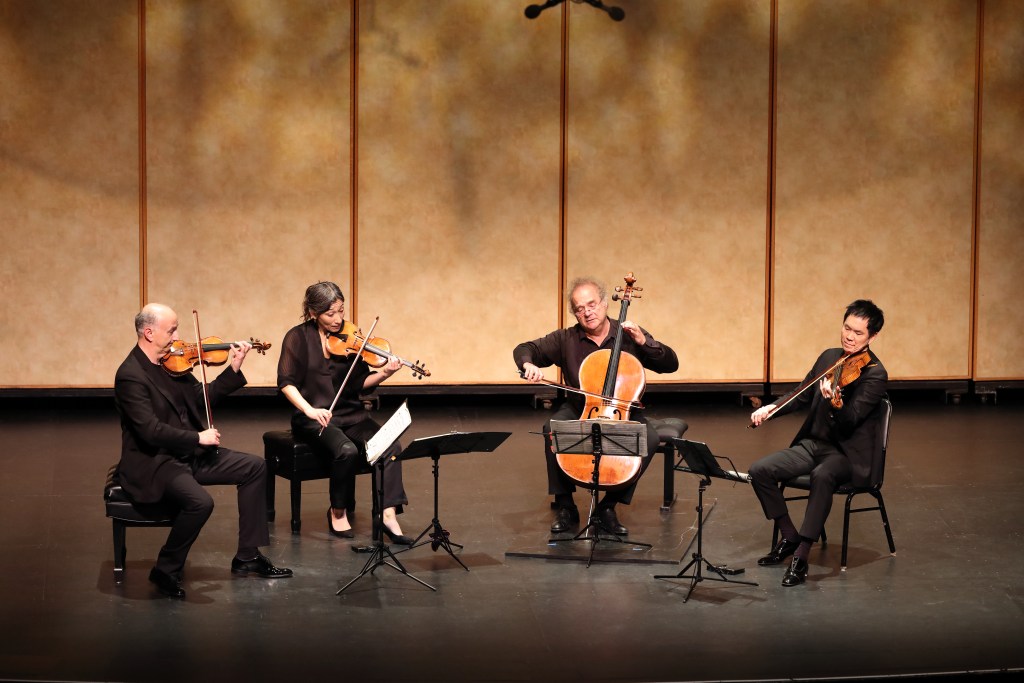
After intermission came the monumental late-period Quartet No. 14 in C-sharp Minor, Op. 131, completed in 1826 and among the last quartets Beethoven composed. It was reportedly his favorite quartet. Schubert, hounded by an inferiority complex regarding Beethoven, commented: “After this, what is left for us to write?”
The Takács rose handily to the occasion of the 40-minute, seven-movement score and its innate challenges. A sense of all-for-one cohesion and resolve was readily apparent, from the muted and moodier opening Adagio to the witty turns and exciting volleys of phrases passed around the stage.
In its time near the upper reaches of the string quartet realm, globally, the Takács has been crowned for its sensitive way with Beethoven (as well as native icon Bartók). At the Lobero, at a historic juncture in the ensemble’s sweeping arc of a lifespan, they — or, more aptly, it — offered the inspired justification for that respect. And they did so by both showing a deep, lived-in understanding of this music and by giving it another critical factor — a sense of fresh wonder.
Fejér went out on a series of high notes.
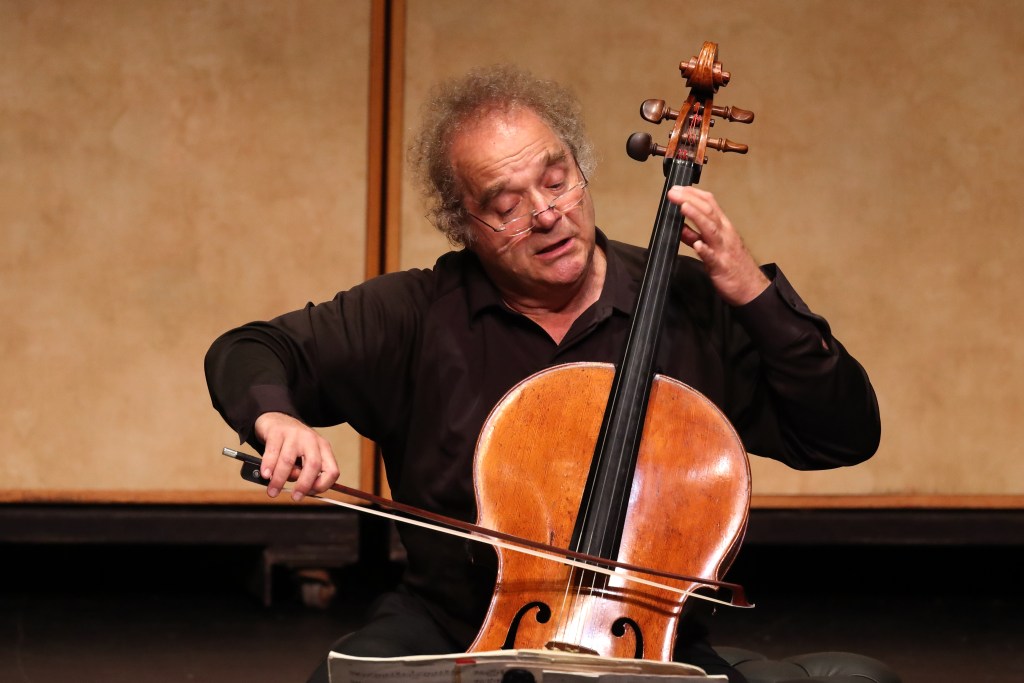
And yes, the cellist did offer a few words, half-reluctantly, at the concert’s end. “This is the moment I’ve been waiting for since 7:30,” he said with a wry grin, “the moment of public speaking with me as the … whatever. Thank you for 20-plus years of support, hugs, and appreciation. Please keep it up for the next 40 years. The new cellist, Mihai Marica, is wonderful, a much nicer guy than I am.” The audience appropriately laughed.
Then he happily introduced the exit strategy of an encore, the slow, sweetly melodic movements from Haydn’s own late, late piece, the unfinished “Lost Quartet,” a gentle nightcap of a closing statement for the night.
Related Posts



Premier Events

Wed, Oct 14
5:30 PM
Santa Barbara
Free Home Hardening & Firescaping Workshop
Fri, Oct 16
7:00 PM
Santa Barbara
Divine Within: A Sufi Exploration of Love & Unity
Sat, Oct 17
9:30 AM
Santa Barbara
Divine Within: A Sufi Exploration of Love & Unity
Sun, Oct 18
9:30 AM
Santa Barbara
Divine Within: A Sufi Exploration of Love & Unity
Fri, Nov 13
7:00 PM
Santa Barbara
Divine Within: A Sufi Exploration of Love & Unity
Sat, Nov 14
9:30 AM
Santa Barbara
Divine Within: A Sufi Exploration of Love & Unity
Sun, Nov 15
9:30 AM
Santa Barbara
Divine Within: A Sufi Exploration of Love & Unity
Fri, Dec 11
7:00 PM
Santa Barbara
Divine Within: A Sufi Exploration of Love & Unity
Sat, Dec 12
9:30 AM
Santa Barbara
Divine Within: A Sufi Exploration of Love & Unity
Sun, Dec 13
9:30 AM
Santa Barbara
Divine Within: A Sufi Exploration of Love & Unity
Wed, Oct 14 5:30 PM
Santa Barbara
Free Home Hardening & Firescaping Workshop
Fri, Oct 16 7:00 PM
Santa Barbara
Divine Within: A Sufi Exploration of Love & Unity
Sat, Oct 17 9:30 AM
Santa Barbara
Divine Within: A Sufi Exploration of Love & Unity
Sun, Oct 18 9:30 AM
Santa Barbara
Divine Within: A Sufi Exploration of Love & Unity
Fri, Nov 13 7:00 PM
Santa Barbara
Divine Within: A Sufi Exploration of Love & Unity
Sat, Nov 14 9:30 AM
Santa Barbara
Divine Within: A Sufi Exploration of Love & Unity
Sun, Nov 15 9:30 AM
Santa Barbara
Divine Within: A Sufi Exploration of Love & Unity
Fri, Dec 11 7:00 PM
Santa Barbara
Divine Within: A Sufi Exploration of Love & Unity
Sat, Dec 12 9:30 AM
Santa Barbara
Divine Within: A Sufi Exploration of Love & Unity
Sun, Dec 13 9:30 AM
Santa Barbara



You must be logged in to post a comment.