• CREATE AN ACCOUNT
  • LOG.IN
  • CONTENTS
  • CLASSIFIEDS
  • ARCHIVE
  • INFO | ADVERTISING | CONTACT US

  • Home
  • News
    • News Main Page
    • NewsFlash
  • A&E
    • A&E Main Page
    • Movie Times
    • TV Listings
    • A&E Blog
    • Art Galleries
    • Best Bets
  • Opinion
    • Opinion Main Page
    • Endorsements
    • Blogs
    • Columns
    • Voices
    • Letters
    • In Memoriam
    • Obituaries
  • Events
    • Today
    • Search
    • Submit
    • Best Bets
  • Living
    • Living Main Page
    • Outdoors
    • Travel
    • Sports
    • Peeps
  • Food & Drink
    • Food & Drink Main Page
    • All Restaurants
    • Delivery
    • All Bars & Clubs
    • Drink Specials
    • Open Now
  • Sports
  • Outdoors
    • Outdoors Main Page
    • Outside Insider
    • Spotlight On
    • Features
  • Classifieds
    • Real Estate
    • Jobs
    • Autos
  • Obits

    Where the Monarchs Hang in Mexico

    The Jade Green Forests of Michoacan


    Sunday, September 27, 2009
    By Silvia Uribe (Contact)
    Article Tools
    Print friendly
    E-mail story
    Tip Us Off
    iPod friendly
    Comments
    Bookmark This
    del.icio.us. del.icio.us.
    Digg! Digg!
    furl furl
    google google
    newsvine newsvine
    reddit reddit
    technorati technorati
    Facebook Facebook
    Yahoo! My Web 2.0 Yahoo!

    My friend Rosty is afraid of butterflies. He insists that these not only beautiful, but also quite innocuous creatures make him feel unsafe when they fly around him, particularly around his face. “My fear comes from the time I was a kid, when a huge moth — the type we don’t see around anymore — was flying on my face and I was unable to get away from it,” he explained. All his life he’s been missing the opportunity to see the monarch butterflies in their natural habitat. He’s missed a lot.

    Allow me to explain. Here in Goleta, as most know, we have a monarch sanctuary, officially known as the Coronado Butterfly Preserve, on the Ellwood Mesa, close to the bluffs. I feel a particular attachment to these royal — by their name and by their rich appearance — insects. There’s a connection between them and me. They call Goleta home, as I do, and they like to travel to Mexico as well. I do this every year, but they are not as lucky. They make one round trip only. They leave during the fall and come back up during the spring. It is their “children's grandchildren” that go south the following fall.

    Millions and millions of monarchs from the central and eastern Canadian provinces and the eastern and midwestern United States embark in an extraordinary effort, migrating to Mexico just as the California ones do. For years it was a mystery where these colorful beings went and where they ended their trip. The scientific community knew that they went to Mexico, but the exact hideouts continued to be a secret known only to local villagers and landowners.

    In 1975, after a serious tagging endeavor on the part of researchers and amateur observers, their arrival sites were revealed. Here’s what we know now about the monarch’s journey:

    The monarchs leave during mid- to late September, continuing until mid-November. They start the trip southward individually, but gather at points along the migration route to rest, feed, and drink. Scientists estimate that the California monarchs are now only about 5 percent of the overall worldwide monarch population.

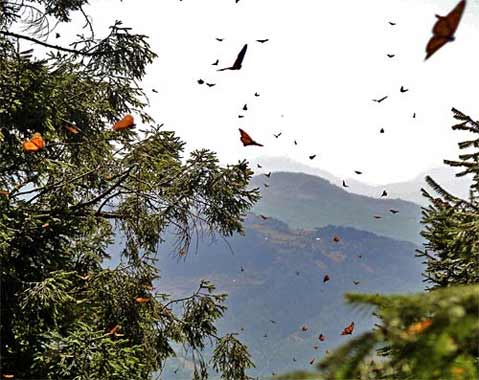
    We still don’t know how these fragile animals get oriented or how they survive such a prolonged trip. Their arrival is an amazing sight. In massive butterfly clouds, they sweep up into the forest located in the mountain ranges of the Mexican state of Michoacan, arriving in November through early December. Some of their main overwintering locations are: Altamirano, Sierra Chincua, El Rosario, Chivati-Huacal, Cerro Pelon, San Andres, Mil Cumbres, La Mesa, Lomas de Aparicio, Piedra Herrada, Oxtotilpan, and Palomas.

    After these locations were made public, a presidential decree in Mexico established in 1986 the Monarch Butterfly Special Biosphere Reserve. This consisted of 60 square miles of protected forest. In the year 2000, with a new presidential decree, the reserve was expanded, creating a protected corridor of 216 square miles. Of the seven sanctuaries mentioned, only two are open to the public: El Rosario and Sierra Chincua.

    According to what researchers tell us, the butterflies have chosen these sites — located just a few hours from Mexico City, and almost 10,000 feet above sea level — because the oyamel firs and other nearby trees, streams, underbrush, and fog combine to form the perfect natural ecosystem for them. I would add that they might have also chosen these paradisiacal enclaves because they are some of the most beautiful places that human or animal eye has ever seen. These locations surround the legendary Patzcuaro Lake and make up an intense jade green, intricate forest. No wonder the little insects make an extra effort to get to such places.

    If you are a nature lover, I encourage you to travel to Mexico and explore the marvelous Biosphere Reserve. You should be prepared to find butterflies by the millions flying or lying around you on the trees, on the bushes, even on the ground. The grandness of the place and its beauty is breathtaking, and it is also a fabulous reminder of how our earth supports all kinds of life, no matter how large or minuscule it may be, if we’re willing to protect its resources.
    Related Links

    • More Goleta Grapevine columns
    Story Help (Click-ability)
    Double-clicking on any word or phrase in this story will open a reference window with definitions and links to other reference material.

    Comments

    Discussion Guidelines

    Great article by Silvia Uribe. As a Monarch enthusiast, I'm appreciative for your paper creating more awareness about the plight of the Monarch butterfly. Here in NW Ohio,
    I dedicated a portion of my yard to the Monarch by planting milkweed and nectaring plants. Visit my free site and learn how you can devote a portion of your yard to Monarch habitat. It's all free and I'd enjoy hearing from you. I'd also enjoy posting this article on the site, giving kudos to Silvia. Robert
    www.wildlifefriendlylawn.blogspot.com/

    Readers say: Thumbs Up: 0 of 0 • Thumbs Down: 0 of 0

    Robert61 (anonymous profile)
    September 27, 2009 at 6:39 a.m. (Suggest removal)

    I have sent this to many of my friends who also enjoy beauty and knowing about the migration habits of the Monarchs.

    Having enjoyed watching the butterflies at the groves for many years, it is nice to be reminded of their long travels.

    As a youngster in Minnesota, I had no idea they traveled so far.

    Readers say: Thumbs Up: 0 of 0 • Thumbs Down: 0 of 0

    bajamama (anonymous profile)
    September 28, 2009 at 1:07 p.m. (Suggest removal)

    For butterfly lovers, I suggest going on Robert's site that he noted. There are so many beautiful pictures of the butterflies and the gardens. It is a very well thought out website. And it is even has a "hot off the press" notation, which took me right back to this site.

    To me the marvels of cyberspace are as inexplicable as the migration instincts of our flying creatures.

    Readers say: Thumbs Up: 0 of 0 • Thumbs Down: 0 of 0

    bajamama (anonymous profile)
    September 28, 2009 at 1:26 p.m. (Suggest removal)

    Post a comment

    Username:
    Password: (Forgotten your password?)

    Comment:

    EVENT CALENDAR

    Previous Month | Next Month

    Today's Events Best Bets Submit an Event

    Local Weather

    Currently:
    Clear Sky
    Temperature:
    50.0°
    Wind:
    5 NE

    Surf Report
    • Specials
    • InPrint
    • Top Emails
    • Best Of 2009
    • 2009 Election Coverage
    • Wedding Guide 2009
    • Blue Green Guide 2009
    • SBIFF 2009
    • Tea Fire 2008
    • Local Heroes 2008
    • Calendar of Fundraisers
    • Local Bands
    • The Independent’s Local Heroes
    • Viggo Hits The Road
    • Elings Park Expansion Shot Down
    • Doggie See, Doggie Do
    • Alison Saar at Atkinson Gallery
    • Sampling My Syrah, Sharing Your Chardonnay
    1. Eating Animals
    2. Producer Must Pay Landscaper
    3. High Noon in the Garden of Controversy
    4. My Swine Flu Experience
    5. Teacher in Trouble
    6. Bella Dolce Bakery Is Born
    • CREATE AN ACCOUNT
    • LOG.IN
    • CONTENTS
    • CLASSIFIEDS
    • ARCHIVE
    • INFO | ADVERTISING | CONTACT US
    Google
     
    Independent.com Web
    Copyright ©2009 Santa Barbara Independent, Inc. Reproduction of material from any Independent.com pages without written permission is strictly prohibited. If you believe an Independent.com user or any material appearing on Independent.com is copyrighted material used without proper permission, please click here.
    This is our Privacy Policy.