• CREATE AN ACCOUNT
  • LOG.IN
  • CONTENTS
  • CLASSIFIEDS
  • ARCHIVE
  • INFO | ADVERTISING | CONTACT US

  • Home
  • News
    • News Main Page
    • NewsFlash
  • A&E
    • A&E Main Page
    • Movie Times
    • TV Listings
    • A&E Blog
    • Art Galleries
    • Best Bets
  • Opinion
    • Opinion Main Page
    • Endorsements
    • Blogs
    • Columns
    • Voices
    • Letters
    • In Memoriam
    • Obituaries
  • Events
    • Today
    • Search
    • Submit
    • Best Bets
  • Living
    • Living Main Page
    • Outdoors
    • Travel
    • Sports
    • Peeps
  • Food & Drink
    • Food & Drink Main Page
    • All Restaurants
    • Delivery
    • All Bars & Clubs
    • Drink Specials
    • Open Now
  • Sports
  • Outdoors
    • Outdoors Main Page
    • Outside Insider
    • Spotlight On
    • Features
  • Classifieds
    • Real Estate
    • Jobs
    • Autos
  • Obits

    Genesis Photo Agency

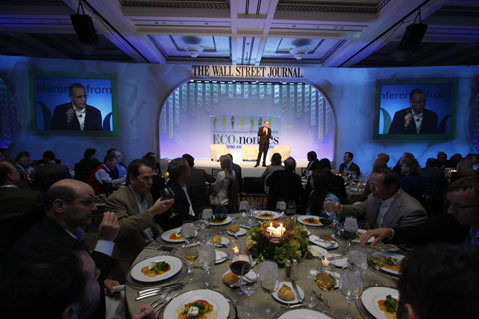
    Corporate execs from around the country dine at the Bacara as they listen to Wall Street Journal editor Robert Thompson explain how the ECO:nomics conference will help them green their business.


    ECO:nomics Returns to Bacara

    Opening Night of Corporate Greening Conference Features Ford and Google CEOs

    Thursday, March 5, 2009
    By Matt Kettmann (Contact)
    Article Tools
    Print friendly
    E-mail story
    Tip Us Off
    iPod friendly
    Comments
    Bookmark This
    del.icio.us. del.icio.us.
    Digg! Digg!
    furl furl
    google google
    newsvine newsvine
    reddit reddit
    technorati technorati
    Facebook Facebook
    Yahoo! My Web 2.0 Yahoo!

    The Wall Street Journal’s second annual ECO:nomics conference kicked off at the Bacara on Wednesday night, as more than 300 corporate executives and environmental advocates from all over the United States converged at the luxurious resort to mingle, dine fine, listen to onstage conversations with esteemed guests, and chat about making their companies more environmentally friendly. Like last year (see independent.com’s 2008 coverage here), the list of invitation-only attendees is a who’s who in the international business and policy-making community, from former vice president-turned-eco-hero Al Gore and European Union president Václav Klaus to legendary oil and gas man T. Boone Pickens and the heads of three major American utility companies. The evening’s top billing went to Ford CEO Alan Mulally and Google CEO Eric Schmidt, who both discussed where they saw renewable resources and reformed energy policy fitting into the country’s future.
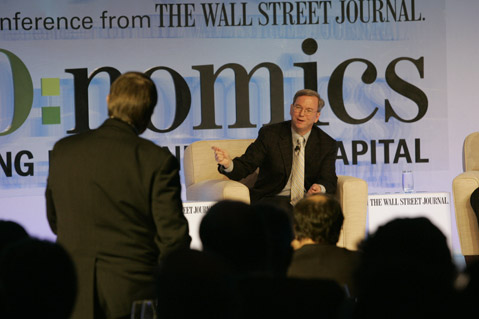
    Michael Morris, head of American Electric Power, debates the potential of renewable energy with Google CEO Eric Schmidt.
    Click to enlarge photo

    Genesis Photo Agency

    Michael Morris, head of American Electric Power, debates the potential of renewable energy with Google CEO Eric Schmidt.

    In his opening remarks to the crowd, the Journal’s Alan Murray reminded that last year everyone was wondering about whether the country was entering a recession, and now the concern is whether we’re actually in a depression. Nonetheless, he said that interest in the conference was high, explaining, “The response was even stronger this year.” Murray discussed how a bad economy makes it perhaps even more challenging for businesses to go green, and cited a poll of everyday Americans showing that while 71 percent want more fuel efficient cars, 56 percent would not be able to pay more for them right now.

    That and other matters were on the table for Ford CEO Mulally, dressed casually in a red sweater vest. Interviewed on two sides by the Journal’s Kim Strassel and Jeffrey Ball, who introduced him as “the only Detroit auto CEO who’s not taking a federal bailout,” Mulally explained how Ford had shed a number of brands because the company had “lost clarity” over the years, and said that now “we just have a laser focus on Ford.” Much of the conversation came off as a big advertisement for Ford’s future line of cars, which, according to Mulally, are going to be the “best in class” in terms of fuel efficiency, quality, and safety. And they will also be smaller, as the company shifts away from the trucks and SUVs that have made up more than 60 percent of its business for the past few years.
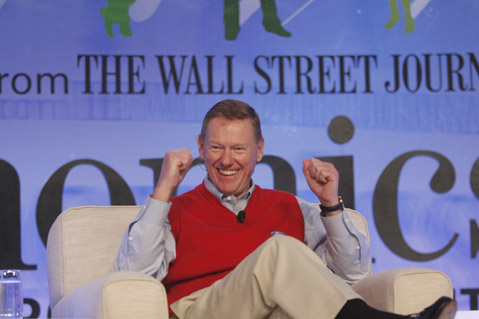
    Ford CEO Alan Mulally discusses his company's future at the ECO:nomics conference.
    Click to enlarge photo

    Genesis Photo Agency

    Ford CEO Alan Mulally discusses his company's future at the ECO:nomics conference.

    Addressing eco concerns, Mulally said, “What we’re all about is being able to make the energy clean and to use the energy clean” and called the Obama administration’s initial energy and environmental plans “a good start.” He predicted that the future will be electric cars, and said that Ford is already moving in that direction.

    What’s most engaging about the ECO:nomics conference is the format for onstage guests, since it does not involve actual speeches but is rather a conversation. And that conversation includes members of the crowd, whom moderators aren’t afraid to call on by name. In the case of Mulally, T. Boone Pickens was called upon to ask a question, and the Texas mogul unleashed a torrent of questions related to natural gas and ending the reliance on foreign oil. “Do you have a bias against natural gas?” Pickens asked Mulally bluntly, to which the Ford exec explained that he ran a “consumer company” and that the market was largely responsible for their fuel decisions.

    Next on stage was Google CEO Eric Schmidt, who’s been on numerous television shows over the past few months touting his company’s national energy proposal, which was developed to help direct official policy and hopefully inspire others to come up with their own solutions. An engaging and earnest talker, Schmidt explained that the motivation behind the Internet search giant Google, whose corporate motto is “Do No Evil,” is to continually ask themselves, “Can we change the world in a positive way?” That was the goal of releasing their own energy plan, which promises among other things that, by 2030, 30 percent of the country’s energy can come from renewable resources and that, despite the costs of getting there, money can be made along the way.
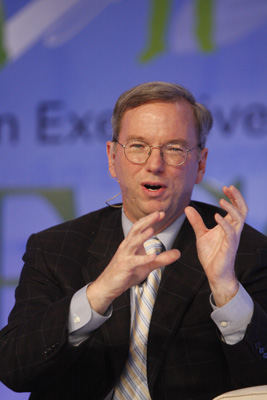
    Eric Schmidt, CEO of Google, discusses his company's proposed national energy plan at ECO:nomics.
    Click to enlarge photo

    Genesis Photo Agency

    Eric Schmidt, CEO of Google, discusses his company's proposed national energy plan at ECO:nomics.

    “Green energy done right is more profitable than the old kind of energy,” said Schmidt, explaining that the $3.5 trillion that would need to be invested over 22 years to make Google’s plan work would actually end up saving $4.4 trillion. “If you invest the right way,” he explained, “you can make money doing it.”

    But he was also cognizant that this is not solely an American problem. “We can solve all the problems in the Untied States,” he said, “and still die, as a society.” That’s because the fast-emerging economies of India and China are still reliant on carbon-based energy. But Google’s energy plan was limited to the United States because that’s where reliable data could be found, explained Schmidt.

    Schmidt was interviewed by the Journal’s Alan Murray, who called upon American Electric Power’s CEO Michael Morris to comment from the crowd. As a leader of one of the country’s biggest utilities, Morris said that he thought Google’s 2030 goals seemed impossible. But that prompted PG&E’s head Peter Darbee to stand up in the back of the room, and explain, “Whenever you put an objective out there, it seems unachievable at first.” Darbee, who was scheduled to sit a panel with Morris the next morning, said that PG&E had made great strides toward renewable resources in a short amount of time, and that it could be done by others too.

    One of the night’s last crowd questions came from the Sierra Club’s Carl Pope, who directed his question to Murray, although his charges seemed aimed at most in attendance. Pope suggested that a lot of this conversation seemed to be coming too late, and Murray defended the conference as an attempt to jump-start progress. But Schmidt responded best, saying, “Change does not occur when things are going well. Change occurs when people are scared.” Schmidt suggested that now—as the American economy teeters on depression, all classes of people are being affected, and communities nationwide are feeling the pinch—is the right time to get something done.

    Tune in later to independent.com for more ECO:nomics coverage.
    Related Links

    • 2008 coverage of ECO:nomics
    Story Help (Click-ability)
    Double-clicking on any word or phrase in this story will open a reference window with definitions and links to other reference material.

    Comments

    Discussion Guidelines

    They hold a purportedly eco friendly conference at the BigCaca which destroyed Haskell's beach and which would eliminate as many environmental protections as it could. Pretty hard to really take any of these mega-millionaires seriously. They live in a world so different from the one you and I inhabit that they become clueless over time to what is going on in the world that you and I inhabit. We will see things get much much worse before they get better, if they ever do.

    Readers say: Thumbs Up: 0 of 0 • Thumbs Down: 0 of 0

    Noletaman (anonymous profile)
    March 5, 2009 at 1:53 p.m. (Suggest removal)

    I love Schmidt the guy talks down to a lot of people, he sets himself and google as examples of leadership. The best was saying they think we can be completely fossil free by 2020 and then proceeded to put down some other companies as not being as cutting edge with the enviroment. Didnt Google just have their 757 at the airport flying a few staff members down from San Jose for a meeting at UCSB? Wonder just how eco friendly that was?

    These corporate chieftains need to actually do something besides pay lip service to green ideas, we do need change but their actions have to match their words. I guess the real lesson from Schmidt is the little people need to clean up their act, they are so rich however those rules dont apply.

    Readers say: Thumbs Up: 0 of 0 • Thumbs Down: 0 of 0

    pointssouth (anonymous profile)
    March 5, 2009 at 7:12 p.m. (Suggest removal)

    Here's a quote from an EdHat reader:
    "That is as green as it gets! Why did they not do a teleconfrence? Gore represents the "do as I say not as I do" government. How much has traveling around the world hurt the environment. If you look hard enough you can see a direct correlation between Gore's speaking engagements and global warming."

    How do we get Hot Air Al to shut up???

    Readers say: Thumbs Up: 0 of 0 • Thumbs Down: 0 of 0

    osotoh (anonymous profile)
    March 6, 2009 at 8:54 a.m. (Suggest removal)

    I agree with Noletaman.

    I, however, think we are being hoodwinked by these eco-elitists and their crazy carbon dioxide theories. If our country finally started living up to protecting the private property rights of everyone, not just the polluting corporations, then this would protect the environment and we would stop polluting toxic chemicals. In other words, the laws against polluting have been on the books, in fact in our constitution, since the inception of this country. However, as a Republican candidate for President in 2008 has said (Ron Paul!), corporations during the industrial revolution colluded with government and eroded private property rights so that they could pollute their toxic chemicals into our environment.

    Forget about carbon dioxide. Global warming is a myth. It is a distraction for those concerned about the environment so that they focus less on the toxic chemicals that industries are polluting and focus on... CARBON DIOXIDE which happens to be air that feeds plants and trees!! I mean, this seems like common sense, but if you do your own research you will find that Al Gore and his global warmning theories are complete nonsense. The icecaps are melting on one side, but are being created at least at the same pace on the other side. Scientists have used ice cores to measure the temperatures of the last few hundred years, and we are not in a hot spell by a long shot. In fact we're in a cool spell still. The medieval warming period was quite a bit hotter and the ocean was not significantly higher during that time.

    http://video.google.com/videoplay?docid=...

    Readers say: Thumbs Up: 0 of 0 • Thumbs Down: 0 of 0

    loonpt (anonymous profile)
    March 6, 2009 at 9:48 a.m. (Suggest removal)

    Post a comment

    Username:
    Password: (Forgotten your password?)

    Comment:

    EVENT CALENDAR

    Previous Month | Next Month

    Today's Events Best Bets Submit an Event

    Local Weather

    Currently:
    Few Clouds
    Temperature:
    48.0°
    Wind:
    5 NE

    Surf Report
    • Specials
    • InPrint
    • Top Emails
    • Best Of 2009
    • 2009 Election Coverage
    • Wedding Guide 2009
    • Blue Green Guide 2009
    • SBIFF 2009
    • Tea Fire 2008
    • Local Heroes 2008
    • Calendar of Fundraisers
    • Local Bands
    • Within the Syuxtun Story Circle
    • Camellia Sasanqua
    • Whole New Ballgame
    • Gratuitous Gore on Highway 154
    • Saul Williams Brings Afro-Punk Tour to Velvet Jones
    • Where There’s a Dill, There’s a Way
    1. Travis Armstrong Is Outta There
    2. S.B. Bank & Trust's Rocky Year
    3. UC Campuses Dominate Rankings
    4. What buildings did architect Julia Morgan design in Santa Barbara?
    5. Rattlesnake and San Roque Side of Jesusita Trails to Re-Open Friday
    6. Sexile
    • CREATE AN ACCOUNT
    • LOG.IN
    • CONTENTS
    • CLASSIFIEDS
    • ARCHIVE
    • INFO | ADVERTISING | CONTACT US
    Google
     
    Independent.com Web
    Copyright ©2009 Santa Barbara Independent, Inc. Reproduction of material from any Independent.com pages without written permission is strictly prohibited. If you believe an Independent.com user or any material appearing on Independent.com is copyrighted material used without proper permission, please click here.
    This is our Privacy Policy.